# Gatherings towards a "Collaborative Editing Protocol"
# Meeting #3
## Time and date
📅 2026-04-23, 19:00-20:00 UTC [(see in your local timezone)](https://www.timeanddate.com/worldclock/fixedtime.html?iso=20260423T19&p1=1440&ah=1)
🔗 Online, at https://meet.jit.si/collaborative-editing-protocol
## Agenda
- **Terminology:** How do we talk about the protocol so that we understand each other?
- What should we call this protocol? It's easier to talk about if the thing has a name
- Client / Editor: The Plugin that talks the protocol with some other component and displays the content of the collaborative document
- Backend: The software that sync between multiple clients / editors
- Should we start a GitHub org?
- We could keep our meeting notes and write a spec together there
- Where are we now?
- Sync realtime text between multiple parties
- Cursor position + selections
- unicode-codepoint offset
- ID the user: name, color, image(?)
- permissions:
- none
- read
- read+write
- auth should be interchangable to allow flexibility in the future
- maybe define some .well-known config for the protocol
- How do editors connect to backends?
- Do we want to have some cep:// scheme (or similar)?
- Folder structure / synced file index
- What constraints could we define for a first minimal prototype of a protocol?
- This could be a starting point for upcoming implementation drafts
- Should we gather more people/projects?
## Notes
- Naming
- Collaborative editing is about syncing, so maybe as a meta idea collaborative collaborative editing protocol
- CEP (Collaborative Editing Protocol) as a temporary name
- we can still think about a better name in the meantime
- Terminology
- some refinement ideas:
- less client-server architecture
- editor <-> local process (optional with peer-to-peer between processes)
- editor <-> server (with peer-to-peer between servers)
- refer to some things as peers
- initial idea by Molly and Erik: client-server architecture is simpler
- server-to-server is still possible
- for example TeamType could be modeled as client <-> daemon (backend) <-> other daemon (backend) <-> other client
- what's a backend?
- different models
- what about a connection client <-> daemon <-> server (cloud)?
- the different possibilities could be next steps after an initial prototype
- we're all on the same page with this
- Organization
- Braid org is a working group, not really an implementation
- could be a part of it
- Molly's idea: keep it separate to reduce complexity and not include a complete ecosystem
- modular specs would be nice
- one wants for example only text synchronization without all multi-file index sync
- purpose of Braid to build app-specific protocols
- Michael would like to invite the CEP into the group
- interopability is core of the protocol anyway
- Braid wiki-like structure looks interesting, but separate repo for now, maybe switch later again
- Where are we now?
- see agenda
- additions:
- merge algorithms (for example singleton vs CRDT)
- implementation status
- Michael integrated Braid-HTTP into HedgeDoc (DiamondTypes and Yjs communicating together)
- Braid-HTTP extensions integrated as well
- practise to see how close are different software projects in reality
- Braid extends "normal URLs" into collaborative synced ones
- Molly reports that plans for HedgeDoc include keeping the non-spec-compliant endpoint for now and add a CEP endpoint as a second one later when the spec is drafted
- Prototype implementation
- Greg built a VS Code and vim plugin using Claude to speak Braid
- writing plugins is really easy and Braid is even more general than CEP
- multiple implementations and design decisions bring more variation
- what is the underlying system for the initial synchronization?
- HedgeDoc uses just a WebSocket
- Braid-HTTP makes a long-polling GET but uses a PUT to send data
- advantage over WebSocket: You don't have to ensure that the receiver has the connection open
- browser implementation with fetch is easy
- HTTP2 multiplexing makes it just one socket under the hood
- there's also Braid-WebSocket and other transports
- maybe make it transport-agnostic?
- make the decision after learning from building different implementations
- Python might not be the best case if we start a prototype
- How much flexibility
- Reach out?
- <https://teamtype.github.io/teamtype/related-projects.html>
- text sync could be too different, so maybe more people makes this more hard
- other "features" could be discussed with other people later
- collaborative text editing comes down to cursors and text, Yjs "binary blob" is the elephant in the room
- more people add more complexity in design decisions
- adding more people is important, but maybe a bit later
- Crucial first: How to synchronize text?
- Up next
- Next meeting: Thursday, 2026-05-28 19:00 - 20:30 UTC
# Meeting #2
## Time and date
📅 2026-03-26, 19:00-21:00 UTC [(see in your local timezone)](https://www.timeanddate.com/worldclock/fixedtime.html?iso=20260326T20&p1=3903&ah=1)
🔗 Online, at https://meet.jit.si/collaborative-editing-protocol
## Agenda
Meta
- We want to shift focus back to working on Teamtype itself => We decided to pause hosting these meetings for now. Any one wants to 'take over' the hosting, or should we stay in touch asynchronously?
- Still interested to hear your thoughts on the following topics!
Technical
- Collecting more requirements
- Does the protocol need "undo" capabilities?
- How to give stability guarantees before "final" spec is done?
- LSP-style capabilities?
- Version numbers?
- Feature autodetection
- "Just use the latest version of everything"
- What about e.g. Debian users?
- Syncing single documents vs syncing whole directories
- Hedgedoc use case: Sync one document
- Pair programming use case: Sync entire directory
- Tracking cursor movements across different documents
- Initiating share via editor/IDE?
- Compatibility of Braid's Simpleton https://braid.org/protocol/simpleton and the Teamtype Protocol https://teamtype.github.io/teamtype/editor-plugin-dev-guide.html
- differences
- implications of decisions
- Plugin setup
- What kind of configurability would the editor plugins need?
- How do decide when the editors edit which resource?
- Reference: Teamtype's Neovim plugin: https://github.com/teamtype/teamtype-nvim/blob/main/doc/teamtype.txt
Strategy
- "Directly use LSP" worth investigating/prototyping?
- "Jump to cursor" features would still need plugins
- LSP alway communicates *all* buffer changes to the server, even "remote" ones
- Kind of a hack...
- Prototype by @3timeslazy at https://github.com/teamtype/teamtype/discussions/440
- Good for adoption if the protocol "fits in" with existing protocols like LSP, DAP, MCP?
- Advantages of a standard vs. premature standardization
Next steps
- Collecting resources: Where did you document your protocols?
## Notes
- Musaab introduction
- With Braid, fixed an OT bug in Hedgedoc
- (see Meta in Agenda section, Teamtype team wants to de-prioritize hosting these meetings)
- but interested in staying in touch + collaborating!
- What requirements are needed?
- keeping text in sync
- positions of cursors
- Is Undoing necessary?
- You probably want to keep
- Hedgedoc: Undo per user, only sensible solution
- especially when editing in different areas
- Some undo articles:
- https://loro.dev/docs/advanced/undo
- https://github.com/loro-dev/loro/pull/361
- https://liveblocks.io/blog/how-to-build-undo-redo-in-a-multiplayer-environment
- Y.js undo manager
- Greg:
- When client has CRDT, it could implement the undo
- In the simpleton model, it doesn't
- Editor knows which edits come from whom, then apply reverse operation
- In Teamtype: We don't want the full CRDT in the editor
- Protocol could send an "undo" message to the collaboration server
- Client could have its own undo stack, and update it like the cursors
- One would need to circumvent editor's undo capabilities
- loro uses undo stack per client
- Batching edits, so that you don't need to undo characters individually? Group them together to words, for example?
- Different editors have different concepts of what a unit of work to be undone is.
- Leave this up to the editor, or integrate it into the protocol?
- Could be a "recommendation" on how to implement the undo
- Have it as an extension?
- Common core set, capability exchange?
- Extensibility = more complexity
- Tradeoff: Fewer Features, but standardized vs more features, but not really standardized (as quickly)
- Path of Hedgedoc: Switched to full CRDT, can now use undo within that
- Seems as if undoing can be done client-side either way: CRDT has full info, simpleton can implement undo stack
- Syncing single files vs whole directories
- Braid: Synchronizes state
- Extension: State of a directory, "Index"
- JSON array, links to other resources
- Syncing single files doesn't seem enough
- Either sync everything in one datastructure
- Sync an index, have parallel sync of documents
- Features in the index:
- Create, delete, rename
- "Where is everybody currently?"
- Identifiers for each document (as in e.g. the Reflection editor)
- Moving/renaming is not a common operation when text editing
- File systems have identifier concept
- How to track symlinks? Identifiers would make that easier
- Moving is an optional feature in Braid's index
- Base data schema + extended patch type
- Tree structure vs flat index?
- Should scale to millions of files?
- Syncthings top 1%tile users have over 1 million files: https://github.com/syncthing/syncthing/pull/10516#issuecomment-3707115707
- Braid's index can nest, or be flat
- Index at the root level that points to everything in depth
- Or point to subdirectories
- Having the ability to use parts of the tree might be nice
- permissions
- subsets
- Folders as different entry points into project could allow to share different parts of a project
- Consensus: Directory tree structure?
- You encounter file structure quickly
- Flat structure might be enough in some cases
- Written option might help to see if we have consensus
- Step back: Should it scale to millions of files?
- Musaab contributed to Syncthing
- Supporting huge monorepos and the Linux kernel could be great
- Permissions
- Authentication + authorization of who can do what
- Three options: None, only read, read+write
- Permission to open real-time channel?
- Switching between read + read/write maybe enough?
- Related work
- https://www.inkandswitch.com/keyhive/notebook/
- Maybe not exclude; Teamtype could use this!
- Braid, core thing: Server tell client whether its allowed to edit
- not being able to read is obvious to the client
- Auth with header or cookie
- From server standpoint: Users with write permissions
- Client needs to be made aware
- Braid: Flag per file: "is this editable to you"
- Seems to fit the file index approach well
- Braid: Each file has metadata (headers), which can be permissions
- Teamtype could look into read-only files
- in educational/presentation contexts, for example
- Versioning/stability guarantees
- Hedgedoc: No version differences :)
- Standard should probably be implemented as a whole
- work-in-progress implementations don't really matter
- in case of HTTP1, timeline is rather "many years"
- Updating a spec -> lots of work on implementors
- Options:
- capabilities, more complex?
- feature detection == capabilities
- Version numbers could be well-used in a group, we could use that internally
- desining feature detection is more work
- cautionary tale: XMPP; lots of extensions, huge implementation mess?
- "caution for extensive extensibility" :P
- another one: Matrix
- Question: how much will the standard "change"
- Risk: being too rigid/inflexible
- Versioning: More flexible to iterate
- "final proposed version" should be CEP 1.0
- IETF process: RFC gets number
- minor errors are correctable as errata
- new standard would be replacement
- Two phase-approach?
- Go to 1.0 when we know it will last for a long time
- For Teamtype, tempted to switch how positions are defined within a file? Still care about keeping current users happy
- Configurability within the protocol?
- Possible via cookies?
- Configuring the plugin
- Related to the web index?
- Or like in a file explorer: Which application will open which file?
- File explorer also (similar to LSP, below) relies on file endings
- or magic bytes etc
- Special case for Teamtype?
- But every editor plugins should be "prepared" for this use case
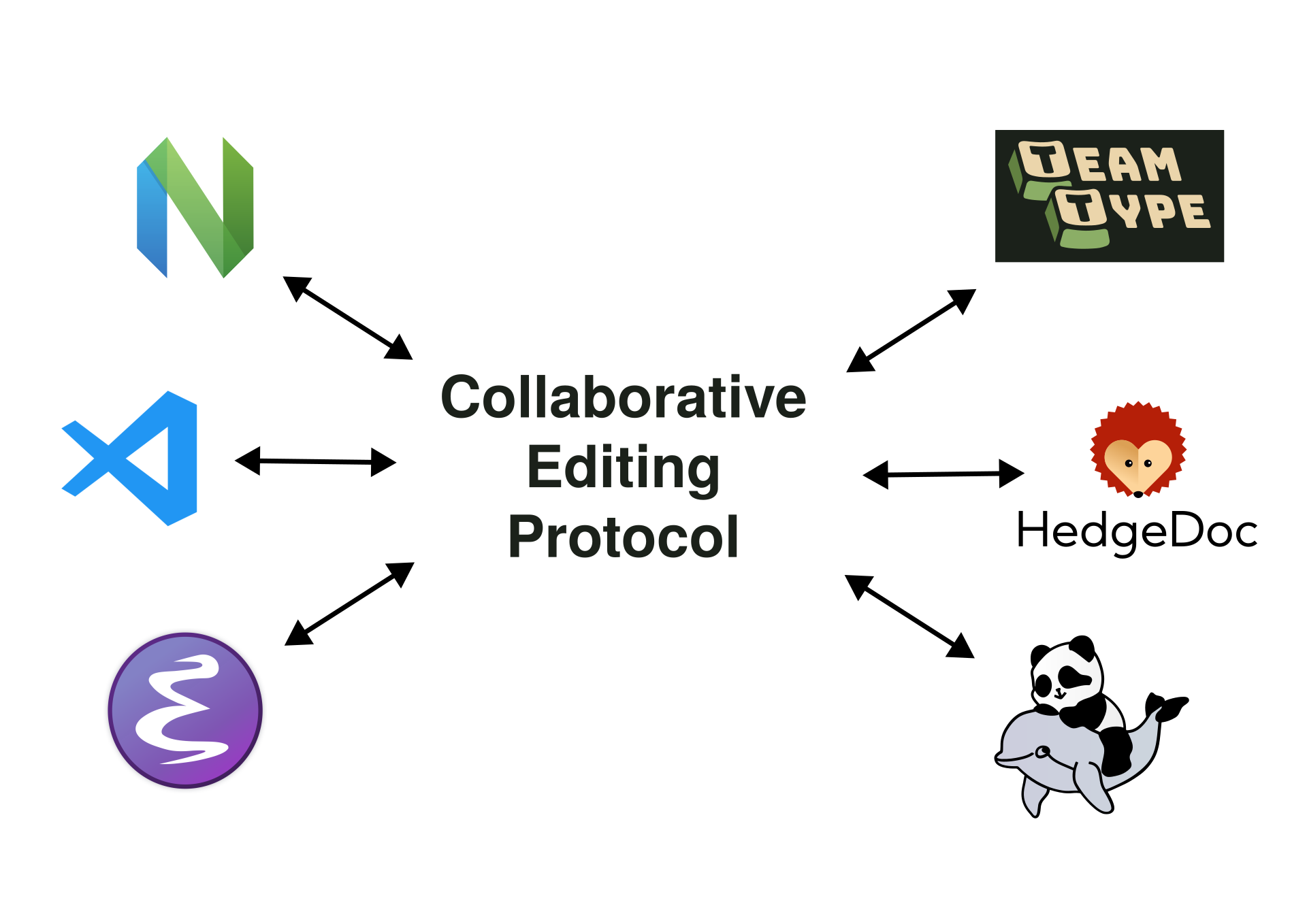
- Diagram around CEP
- LSP has a similiar problem
- Which server should I use for this file
- Made easier by the extension of the file
- URI designed for that
- Do we map external files to the filesystem?
- For Teamtype, we do/need that
- Is the "Teamtype plugin" on the left of the CEP diagram?
- Can you sync between the sync engines or not?
- Goal for the plugins: Allow it to connect to Teamtype; or Hedgedoc; or other collaborative applications
- Simpler than connecting the backend
- Example: making the TeamType wormhole key as a URI scheme: `wormkey:`
- Example: `wormkey:6-eskimo-clockwork`
- Example: `wormkey:6-eskimo-clockwork/some-file`
- Equivalent to running `ethersync join 6-eskim
o-clockwork` and then reading `./some-file`
- Braid equivalent: `https://foo.com/some-file`
- URI scheme per backend?
- braid:...
- hedgedoc:...
- Why are the schemes necessary?
- Should the "sync backends" (Teamtype/Braid/Hedgedoc) be exchangeable
- Are we constrained to a "transport"?
- Consensus? "Only" connecting editors to collaboration servers
- Braid wants the same protocol between backends, as well as servers
- Backends vary: Teamtype directory structure vs Hedgedoc document
- Michael: We don't need to force it, just want to be wary of forcing backends to be different.
- Collecting resources (also see below end of Meeting 1)
- [ ] Have written specifications
- Braid
- Teamtype
- HedgeDoc
- Future of these meetings
- If Teamtype feels the need for another gathering, we would take it up/get together again
- Molly: Monthly meetings would be helpful, but we talked about many aspects, time to start hacking
- Set up a Github organization? Discuss organization next time?
- Make meetings shorter? Coordination problem
- Some kind of meeting could help to keep this project alive?
- Next time, showcase projects?
- Chatroom :scream:
- https://matrix.to/#/#collaborative-editing-protocol:kif.rocks
- Molly can host <3
- 2026-04-23 19:00 UTC, same call room, 1h
# Meeting #1
**The purpose of this meeting is to gauge interest in forming a group that works towards refining & standardizing a protocol giving real-time collaboration capabilities to existing text editors.**
We believe in interoperable, free protocols, open source, and working in the open. If this speaks to you, join us! :)
## Time and date
📅 2026-02-26, 19:00-21:00 UTC [(see in your local timezone)](https://www.timeanddate.com/worldclock/fixedtime.html?iso=20260226T20&p1=3903&ah=1)
🔗 Online, at https://meet.jit.si/collaborative-editing-protocol
## Background
The idea is inspired by how the *Language Server Protocol* allows interoperability between text editors and tools providing "language intelligence" like code completions or type information.
We envision a similar protocol (working title: "Collaborative Editing Protocol") for real-time collaboration that text editors (or their plugins) can implement. This would enable building programs speaking this protocol, that could enable things like "editing a Hedgedoc with Neovim", or peer-to-peer pair-programming between VS Code and Emacs.
- Moritz and blinry gave a talk at FOSDEM opening the discussion for this meeting: [Teamtype: multiplayer mode for your text editor – Towards a Collaborative Editing Protocol](https://fosdem.org/2026/schedule/event/CQHN8T-teamtype-towards-a-collaborative-editing-protocol/) (15 min)
- Read Teamtype's current [Editor plugin development guide](https://teamtype.github.io/teamtype/editor-plugin-dev-guide.html#the-daemon-editor-protocol).
- Teamtype also maintains a [list of related projects](https://teamtype.github.io/teamtype/related-projects.html).
## Agenda
- Quick context: Vision for the protocol
- Round of introductions:
- Why are you here?
- What interests you in a protocol giving real-time collaboration capabilities to text editors?
- Which experience do you have with standardizing protocols?
- Demos of prior work, if there's interest
- Teamtype
- Hedgedoc bridge
- Braid editor plugins
- *Feel free to add your tool, and give a demo!*
- Scope
- What are wishes/ideas for what the protocol should be able to do?
- Can we identify any non-goals?
- What would the protocol need so that it's useful for your project?
- Technical details
- Options for base protocol
- JSON-RPC/msgpck-RPC to allow binary and smaller messages
- LSP (extension?)
- Braid-HTTP
- *more*?
- Base unit for position in text
- Unicode codepoint offset
- Line/column
- Approaches for versioning the protocol itself
- Strategy
- Advantages of a standard vs. premature standardization
- Shared ownership vs. project stewardship
- Possible routes towards a standard
- Technical definition
- Reference implementation
- Best practices?
- Collecting resources: Where did you document your protocols?
- What could be our next steps?
- *Feel free to expand!*
## Attendees
If you're interested in joining, please add your name and background below:
| Name | Background
| --------------- | ----------
| Moritz | Co-lead of the [Teamtype project](https://github.com/teamtype/teamtype)
| blinry | Co-lead of the [Teamtype project](https://github.com/teamtype/teamtype)
| Mike Toomim | Contributor to [Braid.org](https://braid.org)
| Musaab Khan | Contributor to [Braid.org](https://braid.org)
| Caleb Maclennan | FOSS developer
| Molly | HedgeDoc Developer
| Erik | HedgeDoc developer
| Jonah | Commiter for [Eclipse Open Collaboration Tools](https://github.com/eclipse-oct/open-collaboration-tools)
| Max | FOSS dev [Nextcloud Collectives app](https://apps.nextcloud.com/apps/collectives)
| Marc | [Teamtype Jetbrains guy](https://github.com/teamtype/teamtype-jetbrains/) |
| You? |
## Discussion Notes
- no notes in Teamtype yet :D
### Intros
- Moritz
- timekeeping today :)
- Jonah
- Typefox
- Open Collaboration Tools
- Theia/VS Code, now branching out
- Protocol embedded in the plugins
- Marc
- Jetbrains plugin for Teamtype
- Interested in mob programming, mob.sh
- Wanted IntelliJ <-> Neovim collaboration
- Greg
- Working on Braid
- Braid: More than text editor sync!
- Molly
- Working on Hedgedoc, 1.x + 2.0
- inherited the project 5 years ago
- Michael
- Co-founder of Braid
- Interoperable state sync
- Helps interoperable state sync
- Coming up with standards
- Musaab Khan
- github.com/bxff
- Caleb
- Also for non-programmers
- Consulting for publishers
- Working with people not familiar with version control
- Problem: Typesetters don't necessarily understand the technical pipeline
- Long experience with open source, pair-programming w/ Vim + Tmux
- Rob
- Microsoft; here in private capacity
- Interest in collaborative editing
- Contexts like document production
- Michl
- Interested in the technology
- Mob programming!
- Interested in CRDTs
- Erik
- Hedgedoc
- Rewrite still ongoing -> CRDTs, nicer looks
- Exploring in possible integration with Teamtype
### Demos
- Teamtype
- Teamtype-Hedgedoc bridge
- Braid
- Parts that synchronize:
- Emacs
- Chrome extension
- Web component
- File system
- Goal: State Synchronization (generalization of text sync)
- Braid-HTTP as an extension to HTTP
- HTTP -> sync
- 4 extensions
- Broad interop, map them together to a common model
- Extend HTTP to P2P
- Iroh, QUIC
- Edit history visible in dev tools
- Emacs plugin has ~600 lines to speak HTTP
- Another ~600 lines to implement the sync itself
- Simpleton algorithm doesn't keep history, and relies on the server to do the transformation
- Open Collab Tools
- needs a server instance which acts as a message relay and handle authentication
- Open Collaboration extension in VS Code
- Monaco integration in the browser
- Shows open files
- Protocol via websocket, msgpack
- broadcast, to everyone
- notification, to specific user
- requests, mostly to the host but can go to everyone
- like 'stat'
- Y.js as a CRDT library
- One person shares, others have virtual view on the file system
- IntelliJ integration on the way with a nodeJs based service process doing the CRDT and lifecycle management
- service process communication is JSON-RPC via stdio
- Hedgedoc
- Version 2
- list of latest/recently visited notes
- Y.js
- REST API with access token
- permission system
- marking as public
- upload management
- notes with multiple URLs
- technical
- websockets
- JSON (easier to debug) on top of Y.js
- syncing several states: users, cursors
- authorship tracking
- maybe switch to CBOR instead to save bandwidth
- Version 1
- Socket.IO, OT-based
### Scope
- Wishes/ideas
- Requirement ideas
- Common
- Sync text in "realtime"
- Multiple participants
- Sync cursor positions + selections
- ID for the user: name, color, image
- compact/binary protocol?
- Not needed by everyone
- Hedgedoc: Extensibility for new message types
- Permission changes
- Some requests might be very tool-specific?
- OCT also would need custom messages
- Diagram types, not just text
- Teamtype: Directory sharing, not just single files
- Michael: HTTP also extensible
- Syncing single files vs syncing full directories
- Braid: text content type vs index content types
- P2P URLs?
- Opening specific files
- Content layer vs interaction layer
- Syncing binary files
- Scope
- Q: Mainly focus on plaintext? Or make it general?
- Custom sync engines for different content types
- Michael: First step towards general picture
- Teamtype uses two protocols: Daemon-daemon and Editor-daemon
- Breaking these up seems useful?
- Daemon is rebasing edits for the editors
- Braid's collapsing time machines
- Editor just needs to speak the simpleton merge-type
- Feature ideas
- authorship tracking
- Hedgedoc stores user of that edit
- permissions
- chats about the document
- annotation
- Non-features
- Rich-text?
- Audio/video channel
- Many teams already have that?
### Technical
- Base protocol
- Hedgedoc: Emotionless, whatever works
- Goals: Good developer experience
- We want it to be used; for devs should be easy to "just use it"
- Molly: SDK is nicer than "just a spec"
- Libraries make it easy, simple protocol makes it easy
- Extensibility
- JSON-RPC makes transferring binary content harder
- Reduce number of layers
- LSP wrapper as an "easy win"
- Base unit for position
- Greg: Care about Unicode code points, \r\n
- "most simple way to represent things"
- Line/column not useful for soft line wrapping
- Tools that are not code editors
- Line/column was copied from LSP
-
- Versioning
- IETF people don't tend to design in versioning
- consensus -> protocol "already works" for everyone
- resumable upload spec added a version number, but got removed again
- version numbers for internal development only
- LSP-like capabilities checking
- clients and servers signal what they can do to each other
- Braid uses different merge-types, hopefully implementors implement them similarly
- Different merge types can be used for different CRDTs behind them
### Strategy
- Braid is aiming at an IETF standard
- Motivation: We don't want 5 different versions [insert xkcd here] (https://imgs.xkcd.com/comics/standards.png)
- IETF represents the whole Internet
- first iteration was a websocket one
- broke spec up
- Dreaming of the future of "one distributed web"
- Molly, options:
- using Braid as a very general solution
- "Meta protocol"
- Collection of protocols that form the "collaborative editing" experience
- Express as constrained usage of Braid-HTTP
- Alternatives to IETF process
- Example: JSON-Schema, was IETF draft
- If protocol is "good enough", it will spread
- LSP was also specified by Microsoft
- Might be cool to connect to each others
### Resources
- https://braid.org meets every 2 weeks
- Braid Discord: https://discord.gg/nvPQN7FgDX
- Braid Mailing List: https://groups.google.com/forum/#!forum/braid-http
- Michael Toomim (signal, imessage, whatsapp): +1-510-282-4312 and toomim@gmail.com
- Index/Directory sync spec: https://braid.org/protocol/web-index
- Multiplayer cursors sync spec: https://braid.org/protocol/cursors
- Braided Hedgedoc impl: https://github.com/braid-org/braided-hedgedoc
- HedgeDoc
- Matrix chat for dev related topics: https://chat.hedgedoc.org/dev
- Discourse forum: https://community.hedgedoc.org
- almost weekly development meetings via Mumble, just send a message in the dev chat if interested to join
- <cep@hedgedoc.org>
- Protocol: Y.js + custom commands
- Teamtype
- <teamtype@zormit.de>
- https://teamtype.zulipchat.com is our development chat, has a #editor-protocol channel
- Mastodon account: https://fosstodon.org/@teamtype
- Source code: https://github.com/teamtype/teamtype
- Editor protocol documentation: https://teamtype.github.io/teamtype/editor-plugin-dev-guide.html#the-daemon-editor-protocol
- "Decision documents" https://github.com/teamtype/teamtype/tree/main/docs/decisions
- https://www.open-collab.tools/
- OCX Presentation on the tool https://www.youtube.com/watch?v=m50p6fQOH-w&list=PLy7t4z5SYNaRRGVdF83feN-_uHLwvGvgw&index=3&pp=iAQB
- Jonah Iden (jonah.iden@typefox.io)
-
### Next meeting/next steps
- Meet again in 1 month: March 26th, 19:00-21:00 UTC [(see in your local timezone)](https://www.timeanddate.com/worldclock/fixedtime.html?iso=20260326T20&p1=3903&ah=1)